
The United States Department of Defense is undergoing a large-scale transformation in its approach to maritime security. In a historic shift from the Middle East to the Indo-Pacific, the center of heightened geopolitical competition, the Pentagon is relocating its primary mine countermeasures (MCM) assets.
This process, which began in early 2026, will conclude a long-running chapter involving the legacy Avenger-class minesweepers that have been stationed in the Persian Gulf for three decades. Through a “Pacific-first” strategy, the Pentagon is prioritizing the Indo-Pacific and signaling the need to focus on threats posed by near-peer competitors.
This strategic realignment is particularly relevant for key maritime choke points such as the Malacca Strait and the First Island Chain. However, the shift leaves a gap in the North Arabian Sea that the U.S. Navy hopes to fill with more flexible, though less specialized, assets.
The Sunset of the Avenger Class in Bahrain
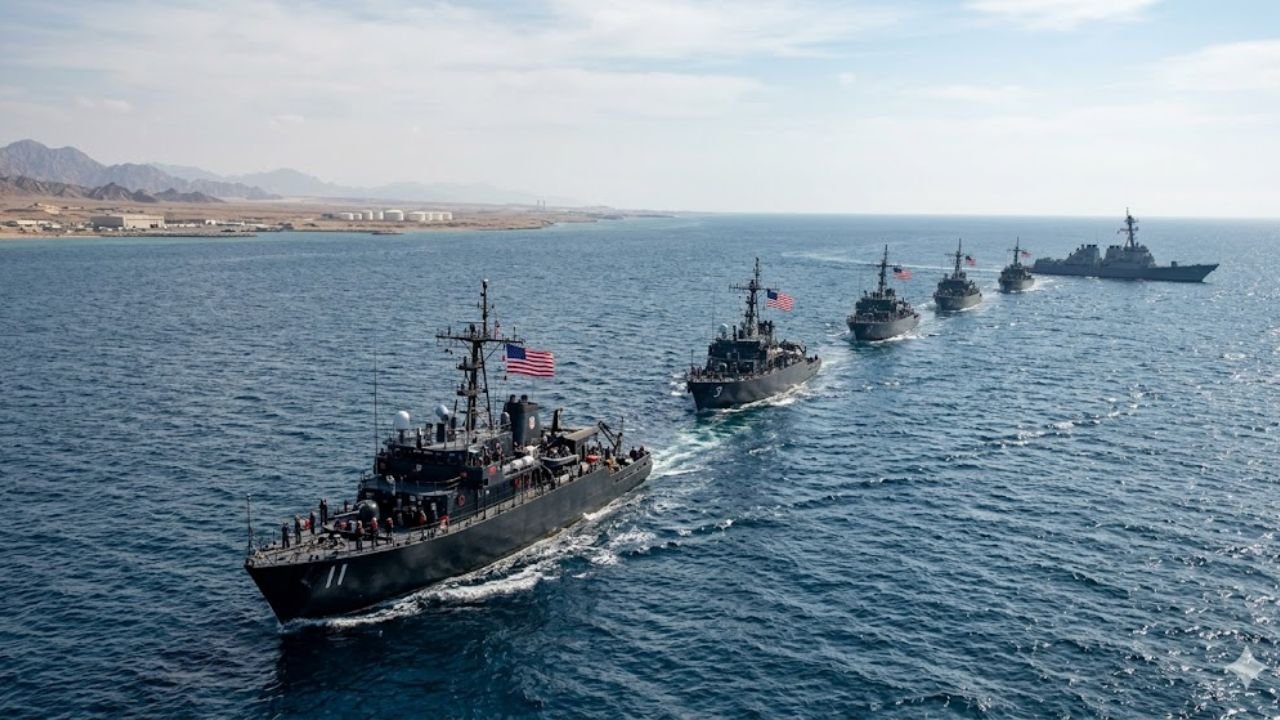
The Avenger-class ships, including USS Devastator, USS Dextrous, USS Gladiator, and USS Sentry, have long been part of the U.S. 5th Fleet’s operations in the Persian Gulf. Built with glass fiber hulls to reduce magnetic detection, these vessels played a critical role in countering potential Iranian mining threats in the Strait of Hormuz.
Beginning in early 2026, the Pentagon decided to retire these aging platforms from the Middle East and consolidate the remaining active vessels at U.S. Fleet Activities Sasebo in Japan. This move positions the Navy’s most specialized deep-water mine-hunting capabilities within the operational area of the 7th Fleet, covering the East China Sea and the Taiwan Strait.
This relocation represents more than a simple shift in geography. It marks a strategic repositioning toward areas where naval mine warfare threats from major competitors are considered most likely.
U.S. Mine Warfare Asset Distribution (2025–2026)
| Asset Class | Previous Station (Mid-2025) | Current Station (March 2026) | Primary Mission Focus |
|---|---|---|---|
| Avenger-class MCM | Bahrain (4) / Japan (4) | Japan (4 Active) | Deep-sea mine neutralization |
| Independence-class LCS | San Diego / Training | Bahrain (3-4) | Distributed mine hunting using unmanned systems |
| 31st Marine Expeditionary Unit | Japan (Sasebo) | En route to Middle East | Expeditionary response and amphibious EOD |
| Mobile Unit 5 | Guam / Japan | Indo-Pacific Wide | Underwater ordnance disposal |
Modernizing the Mine Warfare Doctrine
The departure of legacy minesweepers from the Middle East does not mean the United States is abandoning counter-mine operations in the region. Instead, the Navy is shifting toward a new operational model centered around the Independence-class Littoral Combat Ship (LCS) equipped with the Mine Countermeasures Mission Package.
Unlike traditional minesweepers that physically entered minefields to detect and clear mines, the LCS functions as a “mother ship” for a variety of unmanned underwater vehicles (UUVs) and airborne sensors. These systems allow detection and neutralization to occur remotely while the primary vessel remains outside the danger zone.
Although critics point out that the LCS lacks the non-magnetic hull construction of the Avenger-class ships, supporters argue that the platform’s speed, sensor range, and drone integration make it more adaptable for modern naval operations, particularly across the vast distances of the Indo-Pacific.
Pacific Deterrence and the First Island Chain
The relocation of mine countermeasure capabilities to Japan aligns with the 2026 National Defense Strategy’s concept of “deterrence by denial.” Within the Indo-Pacific, planners are especially concerned about the possibility of sea mines being deployed along strategic chokepoints in the First Island Chain.
Rapidly clearing these minefields would be essential for maintaining the movement of carrier strike groups, allied naval forces, and commercial shipping routes.
Strengthening mine warfare capabilities within the 7th Fleet sends a signal to regional competitors that potential asymmetric blockades can be countered with advanced, rapidly deployable response forces. Over the past year, these forces have participated in joint training exercises, including MINDEX 1JA with the Japan Maritime Self-Defense Force.
Risk Management and Regional Gaps
The shift has not been without concern. Changing global trade flows and rising tensions in the Middle East during early 2026 triggered market reactions to the withdrawal of dedicated minesweeping vessels.
To mitigate the perceived security gap, the Pentagon repositioned the amphibious assault ship USS Tripoli and elements of the 31st Marine Expeditionary Unit from Japan to the Central Command area.
This “yo-yo” positioning of forces highlights a continuing challenge for the U.S. Navy: maintaining credible deterrence in both the Middle East and Indo-Pacific while managing a finite fleet and growing operational demands.
Although the LCS units now stationed in Bahrain provide an alternative capability, their limited combat history means analysts and observers are watching closely to see whether the new technology-driven approach can effectively replace the battle-tested minesweeper systems that preceded it.
FAQs
Q1 Why are U.S. Navy minesweepers relocating from the Middle East?
The move is part of a broader strategic pivot toward the Indo-Pacific to address maritime competition with near-peer rivals. Avenger-class minesweepers were redeployed to strengthen the U.S. 7th Fleet, while Littoral Combat Ships equipped with advanced drones assumed mine countermeasure roles in the Middle East.
Q2 How is a minesweeper different from a regular warship?
Minesweepers are designed to safely operate inside minefields. Ships like the Avenger class use wood, fiberglass, and other non-metal materials to avoid triggering magnetic mines. They also produce minimal noise to prevent activation of acoustic mines.
Q3 Is the Middle East more vulnerable to sea mines now?
The United States has transitioned from traditional minesweeping ships to a system that relies on Littoral Combat Ships and unmanned systems. These drones detect and neutralize mines remotely, reducing risk to sailors while introducing newer technologies into high-risk environments.
