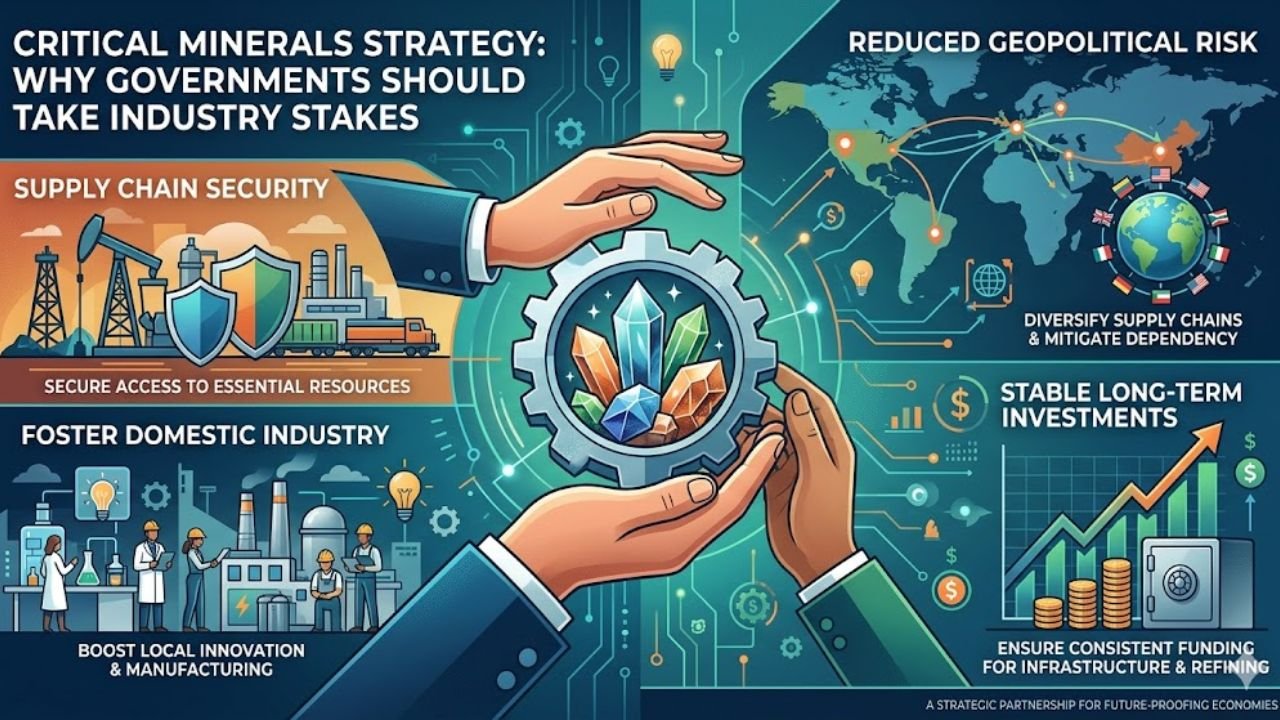
The major industrial competition for the global energy transition has begun, centered on securing critical minerals such as lithium, cobalt, nickel, and rare earth elements. Nations and industries are rapidly restructuring supply chains to support electrification, renewable energy systems, and advanced manufacturing. While decarbonization policies often operate on short-term political timelines, mineral markets are inherently long-term, requiring strategic foresight and sustained investment.
Western economies have traditionally relied on open markets and private capital to source these materials. However, increasing geopolitical tensions and supply chain vulnerabilities have pushed governments to adopt more active roles. This includes direct investments, vertical integration strategies, and state-backed initiatives designed to secure upstream and downstream control over critical mineral resources.
The Strategic Role of State Investment
Government participation in mining and mineral processing projects is reshaping the traditional dynamics of the private sector. By taking equity stakes, states not only provide capital but also signal credibility and long-term commitment. These investments act as endorsements, attracting additional funding while enabling governments to influence strategic decisions and operational standards.
Unlike private equity, state-backed investments benefit from “patient capital,” allowing projects to mature over extended timelines. Mining projects often require a decade or more to transition from exploration to production. Governments can absorb this delay, making them uniquely suited to support early-stage, high-risk ventures that are critical for long-term supply security.
Additionally, state involvement ensures adherence to environmental, social, and governance (ESG) standards. With direct influence at the board level, governments can prevent exploitative practices and promote sustainable development. This reduces the risk of unethical sourcing and discourages a race to the bottom in global mineral markets.
Stabilizing Prices and Securing Supply Chains
Critical mineral markets are highly volatile, with prices subject to geopolitical disruptions, supply shortages, and speculative trading. Government participation in upstream production provides a mechanism to stabilize these fluctuations. Through strategic reserves, long-term contracts, and buy-sell agreements, states can buffer domestic industries against sudden price shocks.
This stability is particularly important for industries such as electric vehicles, renewable energy, and advanced electronics, where input costs directly influence consumer prices. By reducing uncertainty, governments create an environment conducive to sustained industrial growth and technological innovation.
Integrated Industrial Policy and Closed-Loop Systems
High levels of state participation enable the development of coordinated industrial policies. Instead of relying on fragmented global markets, governments can integrate mineral extraction with domestic manufacturing ecosystems. This approach supports the creation of “closed-loop” supply chains, linking mining operations with processing facilities, gigafactories, and high-tech industries.
Such integration enhances national resilience and reduces dependency on external suppliers. It also encourages downstream investments, as manufacturers gain confidence in the reliability and affordability of raw material inputs.
Global Processing Dominance and Strategic Diversification
A major challenge in the current mineral economy is the concentration of processing capabilities in a limited number of countries. While raw materials are extracted globally, processing is often centralized, creating bottlenecks and strategic vulnerabilities. This imbalance restricts international trade and exposes supply chains to geopolitical risks.
Mineral
Primary Use
Processing Concentration
Demand Growth by 2040
Lithium
EV Batteries, Grid Storage
High (China ~65%)
42x
Cobalt
High-Energy Batteries
Very High (China ~75%)
21x
Rare Earths
Magnets, Defense Systems
Extreme (China ~90%)
7x
Copper
Electrical Infrastructure
Moderate (Global)
3x
Nickel
Steel, Batteries
High (Indonesia/China)
19x
To address this imbalance, governments are investing in domestic and allied processing facilities. By decentralizing these capabilities, states can ensure that value-added activities occur within trusted jurisdictions, strengthening economic sovereignty and reducing reliance on monopolistic structures.
Advancing Circular Economies
State-backed entities are also better positioned to invest in long-term innovations such as mineral recycling. Although recycling technologies are currently less profitable than primary extraction, they are essential for sustainability. Government support accelerates research and development, paving the way for circular economies where materials are reused and waste is minimized.
This transition not only reduces environmental impact but also enhances resource security by decreasing dependence on newly mined materials over time.
Strengthening the Social License to Operate
Mining projects often face resistance from local communities due to environmental and social concerns. A government-as-shareholder model helps bridge this trust gap. Public involvement increases transparency, accountability, and confidence that projects will deliver tangible benefits to local populations.
State participation ensures that a fair share of profits is reinvested in regional development, including infrastructure, education, and healthcare. This approach reduces the likelihood of protests and legal disputes, which can delay projects and increase costs significantly.
Moreover, governments can enforce stringent environmental regulations, transforming mining into a more sustainable and socially responsible industry.
Building Resilient Alliances Through Joint Ventures
No country possesses all the resources required for the energy transition. As a result, international collaboration is essential. Governments are increasingly forming mineral-based alliances through joint ventures and cross-border investments.
These partnerships go beyond transactional trade relationships, creating structural ties that enhance stability and mutual security. By sharing ownership and aligning strategic interests, countries can safeguard supply chains and coordinate responses to global disruptions.
Such alliances also strengthen bargaining power in international markets and contribute to a more balanced and resilient global mineral economy.
FAQs
Q1 Does government investment create market inefficiency?
While government involvement may introduce additional processes, it primarily supports rather than replaces private enterprise. By providing patient capital during early, high-risk stages, states enhance overall market stability and encourage broader participation.
Q2 How does this approach impact consumer prices?
In the short term, investments focus on building infrastructure and stabilizing supply chains. Over time, increased efficiency and reduced volatility are expected to lower costs and improve affordability for technologies such as electric vehicles and renewable energy systems.
Q3 Is this strategy compliant with international trade laws?
Most governments structure their investments as minority stakes or through sovereign wealth funds to ensure compliance with global trade regulations. These measures are generally justified under the principles of national security, environmental protection, and economic stability.
Paradise Diving Club is a professional diving center that offers scuba diving, snorkeling, and underwater adventure experiences.